
- What Are Long Tail Keywords in SEO?
- Why Long Tail Keywords Matter in SEO
- Why Are They Called Long Tail Keywords?
- Long Tail Keywords vs Short Tail Keywords
- Real Example of Long Tail SEO
- Importance of Long Tail Keywords in SEO
- Long Tail Keywords for Local SEO
- How to Find Long Tail Keywords
- Best Content Types for Long Tail Keywords
- How to Use Long Tail Keywords Properly
- Are Long Tail Keywords Enough for SEO?
- Why Long Tail Keywords Are Important in 2026
- Conclusion
- FAQs
When people first ask, “what are long tail keywords in SEO?”, they usually expect a technical answer.
But the truth is simple.
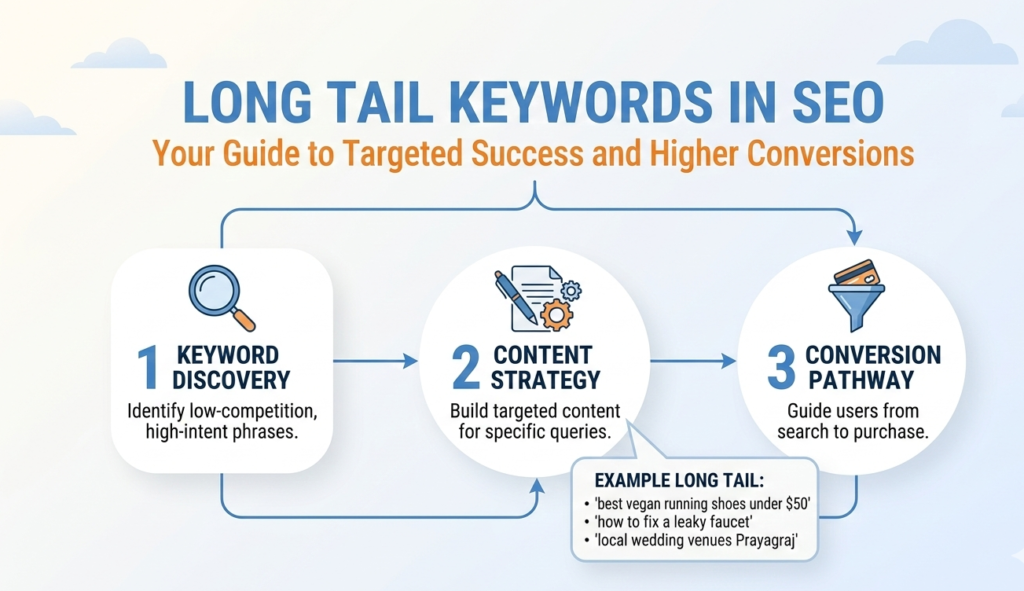
Long tail keywords are specific search phrases (usually 3–7 words) that people use when they already know what they want.
And in SEO, those are the searches that actually convert.
What Are Long Tail Keywords in SEO?
Long tail keywords are detailed and highly specific search queries that target a narrow audience with clear intent.
Examples of long tail keywords:
- “black running shoes for flat feet”
- “best waterproof shoes for monsoon walking India”
- “cheap leather shoes near Indore”
Instead of searching for something broad like “shoes”, users now search in a more precise way.
Simple definition:
Long tail keywords are low-competition, high-intent keywords that help you attract the right audience instead of just more traffic.
Why Long Tail Keywords Matter in SEO
1. High Intent Means Better Conversions
A user searching:
- “what is SEO” is learning
- “SEO services for real estate builders in Indore” is ready to buy
This is the primary advantage of long tail keywords in SEO — you get visitors who are already close to taking action.
2. Lower Competition, Easier Ranking
Short keywords are highly competitive and dominated by big websites.
Long tail keywords:
- Have less competition
- Are easier to rank
- Require fewer backlinks
This makes them ideal for new websites and local businesses.
3. More Relevant Traffic
Long tail keywords don’t bring massive traffic individually, but they bring highly targeted visitors.
That means:
- Better engagement
- Lower bounce rate
- Higher conversion rates
Why Are They Called Long Tail Keywords?
The term comes from a search demand curve.
- Short keywords (like “SEO” or “shoes”) have high search volume
- Long tail keywords form a “tail” of thousands of smaller, specific searches
Individually, they have low volume.
But together, they make up the majority of searches on Google.
Long Tail Keywords vs Short Tail Keywords
| Feature | Short Tail Keywords | Long Tail Keywords |
| Length | 1–2 words | 3–7 words |
| Competition | Very high | Low |
| Traffic | High | Low per keyword |
| Conversion Rate | Low | High |
| Ranking Difficulty | Hard | Easier |
Most successful SEO strategies rely on a mix of both, but conversions usually come from long tail keywords.
Real Example of Long Tail SEO
If you run a digital marketing agency, targeting:
- “digital marketing services” is very difficult
Instead, target:
- “digital marketing agency in Bhopal for small businesses”
- “SEO services in Bhopal for local shops”
- “Google Ads expert in Bhopal”
These keywords may have lower volume, but they attract users who are actually looking for your service.
Importance of Long Tail Keywords in SEO
The significance of long tail keywords in SEO includes:
- Better targeting of user intent
- Higher conversion rates
- Lower SEO competition
- Improved content relevance
- Stronger topical authority
Search engines now prioritize intent and context, not just keywords.
Long Tail Keywords for Local SEO
Long tail keywords are extremely effective for local businesses.
Examples:
- “SEO consultant in Indore for real estate”
- “best dental clinic in Vijay Nagar Indore”
- “home builder for custom homes in Kelowna”
These keywords help:
- Attract local customers
- Increase leads and calls
- Improve visibility in local search results
How to Find Long Tail Keywords
You don’t always need paid tools.
You can find long tail keywords using:
- Google autocomplete
- “People Also Ask” section
- Related searches
- Customer questions
- Sales calls and chats
- Email inquiries
If users are asking questions, they are also searching for them.
Best Content Types for Long Tail Keywords
Long tail keywords perform well in:
- Blog posts
- FAQ pages
- How-to guides
- Comparison articles
- Local service pages
- Case studies
FAQ sections are especially powerful because they match real search queries.
How to Use Long Tail Keywords Properly
To rank effectively:
- Focus on answering questions
- Use keywords naturally in headings and content
- Avoid keyword stuffing
- Write for users, not search engines
Search engines now prefer content that sounds natural and useful.
Are Long Tail Keywords Enough for SEO?
Long tail keywords are powerful, but they are not enough on their own.
You also need:
- High-quality content
- Good website experience
- Internal linking
- Technical SEO
- Trust signals
They give your content a strong foundation, but other SEO factors still matter.
Why Long Tail Keywords Are Important in 2026
Search behavior is changing.
Users now search:
- More conversationally
- More specifically
- Often using voice or AI tools
This makes long tail keywords more important than ever.
They align perfectly with how people actually search today.
Conclusion
Long tail keywords are not about getting more traffic.
They are about getting the right traffic.
Instead of targeting everyone, you target users who already know what they want.
And that is what makes them so effective in SEO.
Related Blogs:
What is Content Marketing? Definition, Examples, Strategy, Funnel
Why is SEO Important? Unraveling the Power of Search Engine Optimization
FAQs
1. What are long tail keywords in SEO in simple words?
Long tail keywords are specific search phrases that help you target users who already know what they are looking for, making them easier to rank and more likely to convert.
2. What is the primary advantage of long tail keywords in SEO?
The main advantage is high user intent, which leads to better conversions and more qualified traffic.
3. What is the significance of long tail keywords in SEO?
They improve targeting, reduce competition, increase conversions, and help websites rank faster in search results.
4. How many long tail keywords should I target in one article?
You should target one primary keyword and several related long tail variations naturally throughout the content.